Share
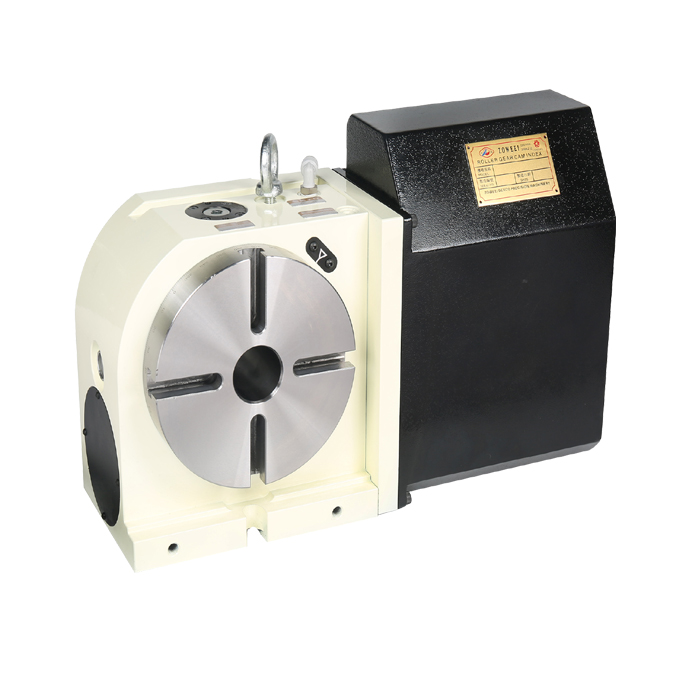
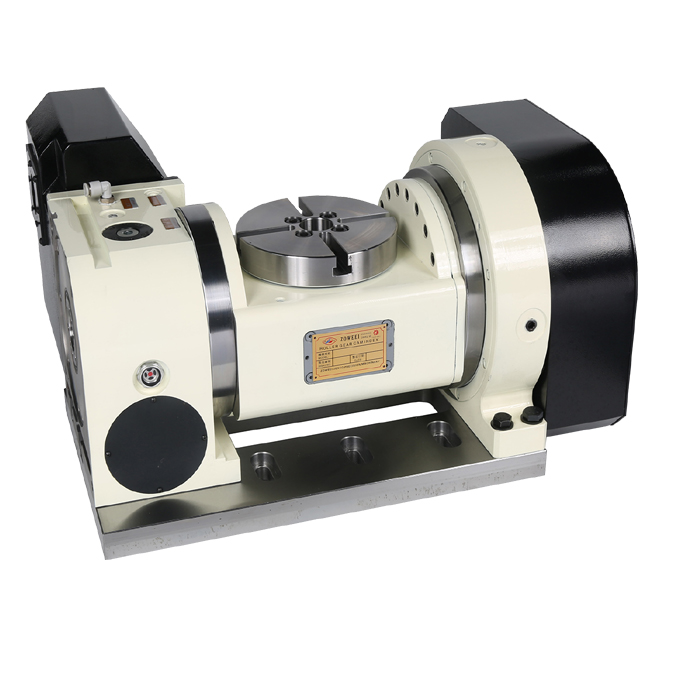
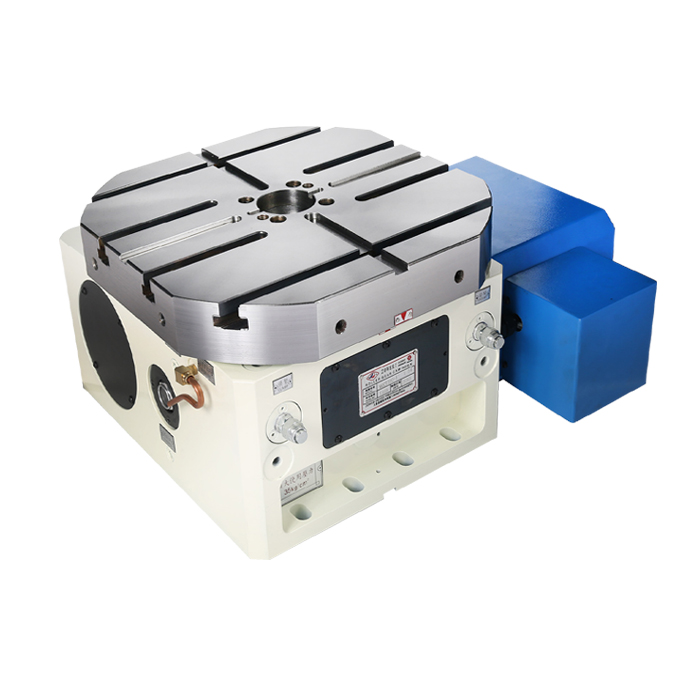
A CNC Rotary Indexing Table is a precision positioning device that rotates a workpiece to a programmed angular position so that multiple sides, holes, slots, or features can be machined without repeatedly removing and repositioning the part.
In a typical CNC machining setup, the rotary table acts as an additional rotational axis. The CNC controller sends a positioning command, the servo motor rotates the table through a transmission mechanism, and the table stops at the programmed angle. Once the required position is reached, a clamping system locks the table so machining can begin.
This combination of controlled rotation, accurate positioning, feedback, and rigid clamping is what allows a CNC rotary indexing table to improve machining efficiency and reduce errors caused by multiple setups.
A CNC rotary indexing table is essentially a programmable rotary axis installed on a machining center, milling machine, drilling machine, or other CNC equipment.
Instead of machining one surface, stopping the machine, manually rotating the workpiece, and setting it up again, the operator can program the rotary table to move automatically.
For example, a part may need holes drilled on four sides. The machining sequence could be:
Machine the first side at 0°.
Rotate the table to 90°.
Machine the second side.
Rotate to 180°.
Machine the third side.
Rotate to 270°.
Complete the final machining operation.
All of these operations can potentially be performed in one workpiece setup.
This is one of the main reasons rotary tables are commonly used to add fourth-axis capability to conventional three-axis machining centers. Commercial CNC rotary tables are commonly designed to connect to machine controls and servo systems so rotational positioning can be programmed like an additional machine axis.
The working process can be divided into five main stages:
The process begins with the CNC program.
The controller determines the required rotary position, such as:
A0°
A45°
A90°
A180°
B30°
depending on how the rotary axis is configured.
For example, when the program commands the rotary axis to move from 0° to 90°, the CNC controller sends the corresponding command to the servo drive.
The rotary table therefore operates in coordination with the machine's X, Y, and Z linear axes.
The servo motor provides the driving force.
Unlike a conventional manual rotary table, where the operator rotates a handwheel, a CNC rotary indexing table normally uses an electronically controlled motor.
The servo system provides several important advantages:
programmable angular positioning;
controlled acceleration and deceleration;
high repeatability;
synchronization with CNC machining cycles;
automatic return to programmed positions.
Some rotary positioning systems may also use stepper motors, while CNC machining applications commonly rely on servo motors where greater control and feedback are required.
The motor usually does not drive the faceplate directly.
A precision transmission system converts motor rotation into controlled table rotation.
Several drive mechanisms are available.
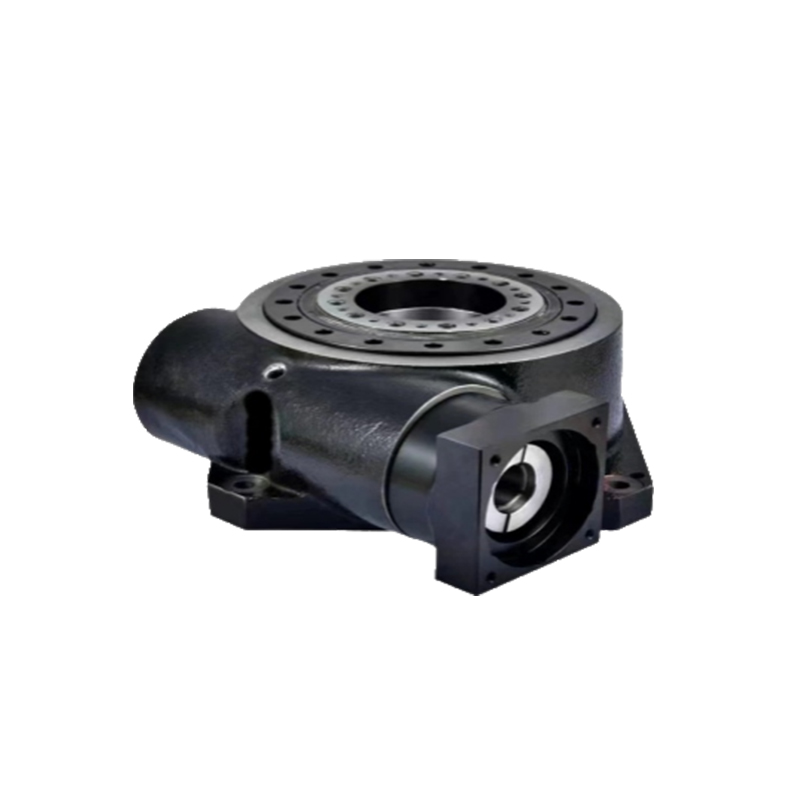
A traditional CNC rotary table often uses a worm shaft and worm wheel.
The servo motor turns the worm shaft, which drives the large worm wheel connected to the rotary spindle.
The reduction ratio increases positioning resolution and torque while reducing output speed.
Precision rotary tables may use dual-lead or adjustable worm systems to reduce backlash. For example, commercially available CNC rotary tables use dual-lead worm gears together with servo motors and adjustable backlash mechanisms.
Worm-driven rotary tables are commonly selected when buyers require a balance between:
precision;
rigidity;
torque;
durability;
and cost.
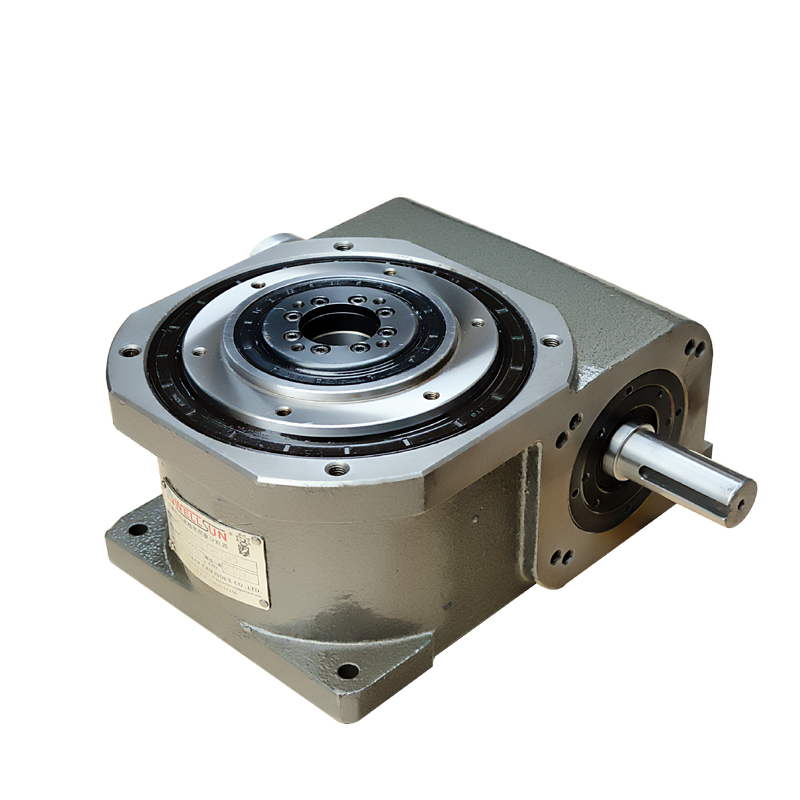
Another design uses a precision cam mechanism.
Cam indexing systems convert input rotation into accurately controlled intermittent output motion. They are particularly suitable for applications requiring repetitive station-to-station indexing, high rigidity, and high production throughput.
They are often used in:
automated assembly;
production machinery;
inspection systems;
welding;
packaging;
high-cycle manufacturing.
A direct-drive rotary table uses a torque motor to drive the rotary axis without a conventional gear reduction mechanism.
Eliminating mechanical transmission components can provide:
higher rotational speed;
faster acceleration;
reduced mechanical backlash;
smoother continuous motion.
Direct-drive technology is therefore particularly attractive for high-speed positioning and simultaneous multi-axis machining.
However, the best drive technology depends on the actual machining requirements rather than simply choosing the most advanced design.
Precise CNC positioning requires more than simply rotating the motor.
The control system must know whether the table actually reached the commanded position.
This is where the encoder or position feedback system becomes important.
The encoder continuously reports position information to the servo controller.
A simplified control loop looks like this:
CNC Command → Servo Drive → Servo Motor → Rotary Table → Position Feedback → CNC Control
If the actual position differs from the programmed position, the servo system makes a correction.
This closed-loop control is one of the reasons CNC rotary tables can repeatedly return to specific angular positions during automated machining.
Reaching the correct angle is only part of the process.
Once positioned, the rotary table must remain rigid while the cutting tool applies force to the workpiece.
For this reason, many CNC rotary indexing tables incorporate a mechanical, pneumatic, or hydraulic clamping mechanism.
A typical sequence is:
Unclamp → Rotate → Position → Clamp → Machine → Unclamp → Index Again
Pneumatic clamping is used on some smaller or medium-duty CNC rotary tables, while larger heavy-duty tables may use hydraulic clamping to achieve greater holding force. Commercial rotary tables are available with both pneumatic disk-clamping systems and heavy-duty hydraulic locking systems depending on table size and cutting load.
The clamping system matters because insufficient rigidity can cause:
vibration;
angular movement;
dimensional errors;
poor surface finish;
reduced cutting performance.
For buyers, clamping torque should therefore be evaluated together with table accuracy and load capacity.

One of the most important specifications for a CNC rotary indexing table is indexing accuracy.
Suppose a rotary table is programmed to move exactly 90°.
If it stops at 89.998° or 90.002°, the difference represents an angular positioning error.
Even a small angular error can become significant when machining a large-diameter workpiece.
This matters particularly when producing:
bolt circles;
gears;
aerospace components;
hydraulic components;
precision fixtures;
multi-sided parts.
Buyers should therefore check both:
How closely the table reaches the commanded angular position.
How consistently the table returns to the same angular position after repeated movements.
These specifications should not be treated as interchangeable.
A rotary table can have good repeatability but still contain a consistent positioning offset.
Backlash is the small amount of movement that may occur between mating transmission components when rotational direction changes.
In a gear-driven rotary table, excessive backlash can affect:
angular positioning;
bidirectional accuracy;
repeatability;
surface finish;
contouring performance.
For this reason, precision CNC rotary tables may use:
preloaded gear systems;
adjustable dual-lead worms;
precision reducers;
cam mechanisms;
direct-drive motors.
When comparing suppliers, buyers should ask not only:
“What is the indexing accuracy?”
but also:
“How is backlash controlled throughout the service life of the table?”
That question often provides much more useful information about long-term machining performance.
The main advantage is not simply that the table can rotate.
The greater benefit is the reduction of manual workpiece setups.
Consider a rectangular component that requires machining on four sides.
Without a rotary axis, the operator may need to:
machine one side;
stop the machine;
unclamp the workpiece;
reposition it;
realign the datum;
clamp it again;
restart machining.
Each additional setup requires labor and introduces another opportunity for positioning error.
With a CNC rotary indexing table, the workpiece can remain in one fixture while the machine automatically rotates it.
This can provide several benefits:
fewer setups;
reduced operator intervention;
shorter machining cycles;
improved positional consistency;
easier automation;
better machine utilization.
For high-mix or production machining environments, these advantages can be more important than the purchase price of the rotary table itself.
Rotary tables can be used for machining:
transmission housings;
brake components;
engine components;
steering parts;
differential housings.
Multi-side machining can reduce workpiece handling between operations.
Applications include:
structural components;
brackets;
actuator parts;
precision housings;
turbine-related components.
These applications often place greater emphasis on accuracy, rigidity, and repeatability.
Valve bodies and pump housings frequently require holes, ports, and machined surfaces at multiple angular positions.
A rotary indexing table allows these features to be produced without repeated manual repositioning.
Complex cavities and angled surfaces can benefit from additional rotary-axis positioning.
Rotary tables are also widely used for:
drilling;
milling;
tapping;
boring;
inspection;
engraving;
automated positioning.
Understanding how the table works makes the selection process much easier.
Rather than focusing only on table diameter, buyers should evaluate the complete machining requirement.
Provide:
maximum diameter;
maximum length;
fixture dimensions;
workpiece center height.
The table must physically accommodate both the component and the fixture.
Check the manufacturer's allowable load.
Pay attention to whether the published load applies to:
horizontal installation;
vertical installation;
or use with a tailstock.
Large industrial rotary tables can have substantially different load and cutting-force ratings depending on model and installation orientation.
High-precision aerospace machining and general drilling applications may require very different accuracy levels.
Avoid paying for unnecessary precision, but do not select a table whose positioning capability cannot meet the finished-part tolerance.
For production machining, repeatability is particularly important because the table may perform thousands of identical indexing cycles.
Clamping torque should match the cutting forces generated during machining.
Heavy milling normally requires higher rigidity than light drilling or inspection positioning.
Higher rotary speed can reduce non-cutting time, especially in high-volume production.
However, maximum speed should be considered together with:
load inertia;
acceleration;
table diameter;
fixture weight.
A hollow-center design can be valuable when the application requires space for:
long shafts;
hydraulic lines;
pneumatic tubing;
cables;
fixture connections.
Hollow rotary tables are specifically designed to allow wiring or piping through the center while maintaining a compact machine layout.
The table must be compatible with the machine control platform.
Common systems can include:
FANUC;
Siemens;
Mitsubishi;
Heidenhain;
other CNC controllers.
Buyers should confirm servo motor, encoder, drive, interface, and parameter requirements before ordering rather than assuming that every rotary table can be connected directly to every machining center.
Some CNC rotary tables can be used both vertically and horizontally.
The installation orientation affects:
available workpiece space;
load capacity;
fixture design;
machining strategy.
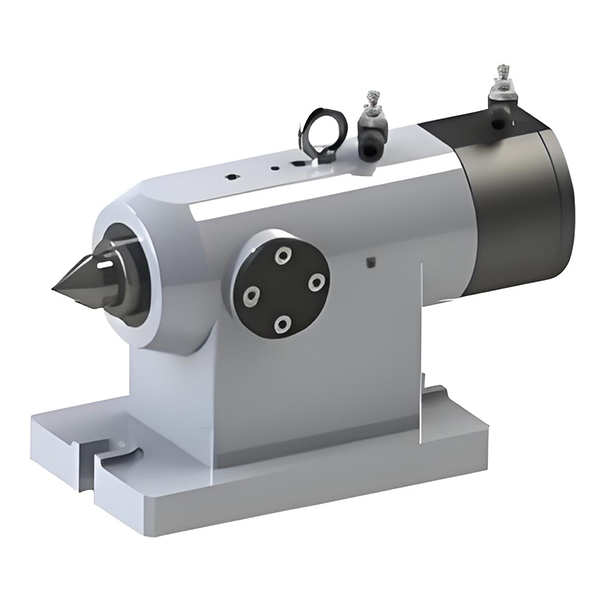
Long shafts or slender components may require a tailstock to support the opposite end of the workpiece.
This reduces deflection and improves stability during machining.
| Feature | CNC Rotary Indexing Table | Manual Rotary Table |
|---|---|---|
| Positioning | Automatic | Manual |
| Control | CNC / Servo | Handwheel |
| Repeatability | High | Operator dependent |
| Automated machining | Yes | Limited |
| Multi-side machining | Efficient | Requires manual repositioning |
| Production applications | Highly suitable | Better for simple or low-volume work |
| Integration | CNC program | Standalone manual operation |
For workshops producing occasional simple parts, a manual rotary table may still be sufficient.
For automated production, complex components, or repeatable multi-face machining, a CNC-controlled rotary table usually provides much greater productivity.
So, how does a CNC Rotary Indexing Table work?
At its core, the process is simple:
The CNC controller commands an angle, the servo motor drives the rotary mechanism, the feedback system verifies the position, and the clamping system locks the table while machining takes place.
Behind this simple sequence, however, several engineering factors determine actual machining performance:
indexing accuracy;
repeatability;
backlash;
drive mechanism;
bearing rigidity;
clamping torque;
allowable load;
workpiece inertia;
controller compatibility.
For buyers, selecting the right CNC rotary indexing table should therefore be based on the complete machining application, not table diameter or price alone.
Before requesting a quotation, it is useful to provide the supplier with the workpiece dimensions, weight, machining orientation, required accuracy, cutting conditions, CNC controller model, installation method, and whether indexing or continuous rotary machining is required.
The more accurately these operating conditions are defined, the easier it is to select a rotary table that delivers reliable positioning, adequate rigidity, and long-term machining performance.
A CNC rotary indexing table is used to rotate and position a workpiece at programmed angles during machining. It is commonly used for multi-side milling, drilling, boring, tapping, and precision component machining.
In many applications, yes. A compatible CNC rotary table can add a programmable rotational axis to a three-axis machining center. However, the CNC control, servo drive, machine parameters, electrical interface, and physical installation must support the additional axis.
Indexing accuracy measures how closely the table reaches the commanded angle. Repeatability measures how consistently it can return to the same position over repeated cycles.
For conventional indexing operations, the table is normally clamped after reaching the programmed position to provide rigidity against cutting forces. During simultaneous rotary contouring, the axis instead remains under servo control while moving.
Backlash can originate from clearance between transmission components such as worm gears or reducers. Precision gear adjustment, preload systems, cam mechanisms, or direct-drive technology can be used to minimize its effect.
Provide at least:
workpiece dimensions;
workpiece and fixture weight;
machining orientation;
required indexing accuracy;
required repeatability;
expected cutting force;
required rotation speed;
CNC controller brand and model;
vertical or horizontal installation;
chuck and tailstock requirements;
through-hole requirements;
indexing or continuous machining requirements.
These details allow the supplier to recommend the appropriate table size, drive system, servo motor, clamping system, and configuration.
No. An oversized table adds weight, inertia, space requirements, and cost. The correct table should provide sufficient load capacity, rigidity, torque, and machining envelope without being unnecessarily large.
A worm-drive rotary table is often suitable for general-purpose precision indexing and applications that require high torque at moderate speeds. A direct-drive table can be more suitable when high rotational speed, rapid acceleration, smooth continuous movement, and minimal mechanical backlash are priorities. The final choice should be based on the machining process rather than drive technology alone.